Rabia Gürer Gürkan
Senior Child Development Specialist
41+ years of professional experience in family education
Introduction
A child development textbook can describe developmental stages. Scientific research can explain developmental theories. However, there is another source of knowledge that deserves attention: long-term observation.
Throughout more than forty-one years of professional experience working with infants, children, adolescents, and families, I have had the opportunity to observe developmental patterns across generations. While every child is unique, one lesson has remained remarkably consistent: children thrive when their developmental needs are understood and respected.
The scientific principles discussed in this article are supported not only by research but also by decades of real-world observations. Over the years, I have seen how supportive relationships, realistic expectations, healthy environments, and responsive caregiving can positively influence a child’s physical, cognitive, emotional, and social development.
Understanding development is not simply about knowing what children can do at different ages. It is about recognizing who they are becoming and providing the guidance, patience, and opportunities they need to reach their full potential.
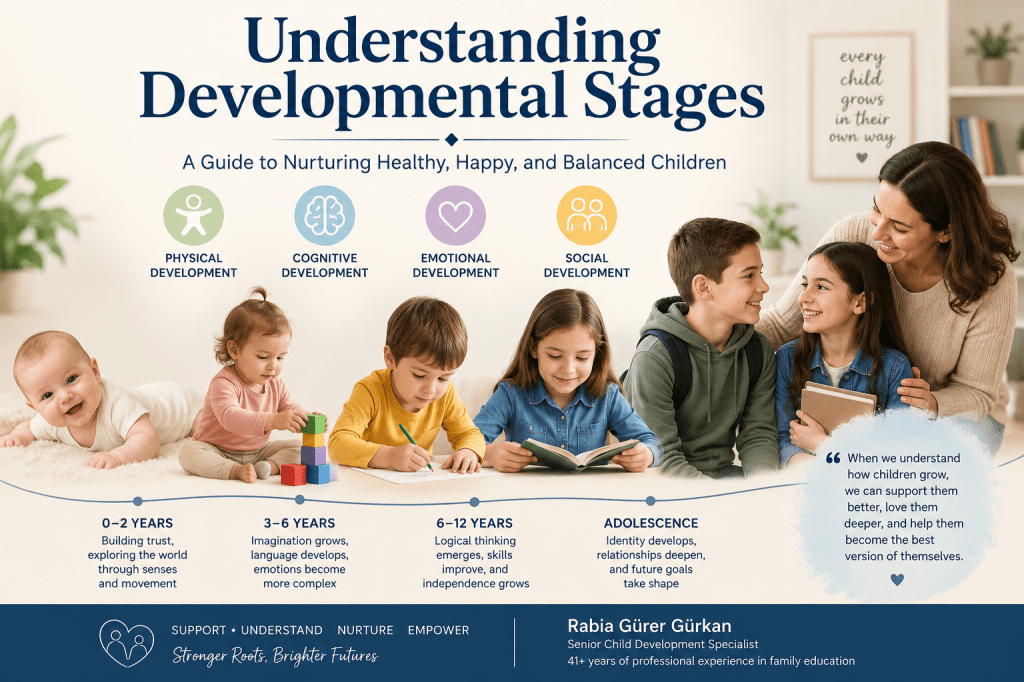
Children are not miniature adults—they are individuals undergoing rapid, dynamic transformations in mind, body, and emotions. From birth through adolescence, children progress through distinct developmental stages, each marked by physical, cognitive, emotional, and social milestones. Understanding these stages is fundamental for parents, caregivers, educators, and healthcare providers who wish to support children in healthy, appropriate, and empowering ways.
This article explores the main domains of development—physical, cognitive, emotional, and social—and outlines age-appropriate developmental characteristics and expectations. The goal is to equip adults with a developmental roadmap that enhances empathy, encourages realistic expectations, and fosters optimal support for a child’s overall growth.
Physical Development: Building the Body and Refining Motor Skills
Physical development encompasses both gross and fine motor skills. It is the foundation upon which a child interacts with their world—through movement, coordination, exploration, and action.
Infancy (0–2 years): This stage is marked by rapid physical growth. Infants develop head control, roll over, sit, crawl, stand, and eventually walk. Fine motor skills begin with grasping objects and evolve into pincer grip and hand-eye coordination.
Early Childhood (3–6 years): Physical agility increases. Children run, jump, climb, throw, and catch with greater control. Fine motor improvements include drawing shapes, using scissors, dressing independently, and beginning to write.
Middle Childhood (6–12 years): Physical growth stabilizes, but coordination, stamina, and strength improve. Children engage in sports, structured physical activities, and develop more complex motor sequences.
Support Tips:
- Provide safe spaces for movement and play.
- Offer age-appropriate toys and tools that encourage both large and small muscle use.
- Encourage outdoor activities to support healthy growth and fitness.
Throughout my professional career, I have observed that children learn best when movement is encouraged rather than restricted.
Cognitive Development: Thinking, Reasoning, and Problem-Solving
Cognitive development refers to the evolution of thinking, understanding, memory, and decision-making. It encompasses language acquisition, attention, and abstract thinking.
Infancy (0–2 years): According to Piaget’s sensorimotor stage, infants learn through sensory experiences and motor actions. Object permanence emerges around 8–12 months.
Early Childhood (3–6 years): Children enter the preoperational stage—thinking becomes symbolic, yet egocentric. They engage in pretend play, but struggle with logical reasoning and understanding other perspectives.
Middle Childhood (6–12 years): The concrete operational stage begins. Children think logically about concrete events, classify objects, and understand concepts like conservation and reversibility.
Support Tips:
- Read and talk to children frequently.
- Ask open-ended questions to stimulate thinking.
- Encourage problem-solving through play, puzzles, and real-life situations.
Emotional Development: Understanding and Expressing Feelings
Emotional development involves recognizing, expressing, and managing one’s emotions, as well as developing empathy and emotional resilience.
Infancy (0–2 years): Emotional expression begins with basic feelings like happiness, sadness, and fear. Secure attachment with caregivers is crucial for emotional security.
Early Childhood (3–6 years): Children begin to label emotions and understand causes. They learn to manage feelings with guidance but may still struggle with impulse control.
Middle Childhood (6–12 years): Emotional self-regulation improves. Children begin to cope with frustration, manage stress, and develop a deeper understanding of complex emotions such as guilt, pride, or empathy.
Support Tips:
- Respond consistently and sensitively to emotional cues.
- Help children label and validate their feelings.
- Model healthy emotional expression and regulation.
Many of the emotional difficulties I encountered over the years were not the result of “difficult children,” but of children struggling to communicate feelings they did not yet know how to express.
Social Development: Building Relationships and Social Understanding
Social development is the process of learning how to interact with others, form relationships, and navigate social norms and expectations.
Infancy (0–2 years): Social interaction begins with eye contact, smiling, and turn-taking in vocalizations. Trust and bonding are established through consistent caregiving.
Early Childhood (3–6 years): Peer relationships become more prominent. Children engage in cooperative play, take turns, and start developing social rules. Imaginative play often involves social roles and norms.
Middle Childhood (6–12 years): Children seek peer approval and develop friendships based on shared interests. They begin to grasp fairness, cooperation, and group identity.
Support Tips:
- Arrange playdates and group activities.
- Teach sharing, empathy, and respect for others.
- Provide guidance on resolving conflicts peacefully.
Children learn social skills not from lectures but from relationships. Family interactions often become a child’s first classroom for empathy, cooperation, and respect.
Age-Appropriate Developmental Expectations: A Framework for Each Stage
0–2 Years: The Sensorimotor Stage
- Rapid physical growth and movement.
- Developing secure attachments.
- Learning through senses and actions.
- Forming basic trust and predictability in relationships.
3–6 Years: The Preoperational Stage
- Rapid language development.
- Magical thinking and egocentrism.
- Strong emotional responses.
- Beginning social play and moral reasoning.
6–12 Years: The Concrete Operational Stage
- Logical thinking and categorization.
- Increasing independence and responsibility.
- Peer influence becomes significant.
- Emotional and social complexity grows.
Why It Matters:
Understanding these stages enables caregivers to:
- Set realistic expectations.
- Recognize normal vs. concerning behaviors.
- Support the child with appropriate strategies.
- Foster confidence and competence in children.
The Role of Environment and Culture in Development
While developmental stages follow predictable patterns, culture and environment shape how and when children reach certain milestones. Parenting styles, societal norms, education systems, and family dynamics play integral roles in influencing development.
For example:
- In some cultures, independence is encouraged early; in others, interdependence is emphasized.
- Access to quality nutrition, healthcare, and education affects developmental outcomes.
- Screen time, media exposure, and technology also influence cognition and behavior.
A culturally responsive approach to child development respects differences and prioritizes the child’s individual context.
The Importance of Observation and Professional Support
No two children develop in exactly the same way. Individual variability is expected. However, caregivers should be aware of developmental red flags and consult professionals if there are concerns, such as:
- Delays in speech or motor milestones.
- Difficulty forming attachments or extreme emotional responses.
- Inability to engage socially or persistently aggressive behavior.
Regular well-child checkups, developmental screenings, and early intervention services are essential tools to support children who may need additional help.
Practical Ways to Support Children’s Development
- Consistency and Routine: Predictable routines help children feel secure and organized.
- Language-Rich Environment: Talk, read, and sing with children daily.
- Active Play: Encourage physical activity and outdoor exploration.
- Nurturing Relationships: Prioritize bonding, affection, and meaningful interactions.
- Open Communication: Listen actively, validate feelings, and provide guidance.
Conclusion
Understanding the developmental stages of childhood empowers parents, caregivers, and professionals to provide optimal support at each step of a child’s journey. Recognizing age-appropriate expectations and developmental needs fosters an environment where children can thrive—physically, intellectually, emotionally, and socially.
By staying informed, observing carefully, and responding with empathy and intentionality, we help shape a future generation that is healthy, balanced, and capable of reaching their full potential.
After more than forty-one years of working with children, adolescents, and families, I remain convinced of one simple truth: development is not a race. Every child grows at their own pace, in their own way, and within their own unique environment.
Our role as adults is not to rush development, but to understand it, support it, and respect it.
When we understand how children grow physically, cognitively, emotionally, and socially, we are better equipped to provide the guidance, patience, and opportunities they need to thrive.
Healthy development begins with understanding—and understanding begins with observing the child in front of us.
References
- Berk, L. E. (2013). Child Development (9th ed.). Pearson Education.
- Shonkoff, J. P., & Phillips, D. A. (Eds.). (2000). From Neurons to Neighborhoods: The Science of Early Childhood Development. National Academy Press.
- Piaget, J. (1952). The Origins of Intelligence in Children. International Universities Press.
- Vygotsky, L. S. (1978). Mind in Society: The Development of Higher Psychological Processes. Harvard University Press.
- CDC. (2022). Developmental Milestones. Centers for Disease Control and Prevention. https://www.cdc.gov/ncbddd/actearly/milestones/index.html
- WHO. (2021). Nurturing Care for Early Childhood Development: A Framework for Helping Children Survive and Thrive. World Health Organization.
Tags: Child Development, Developmental Stages, Child Development Milestones, Early Childhood Development, Physical Development, Cognitive Development, Emotional Development, Social Development, Parenting Tips, Family Education

