
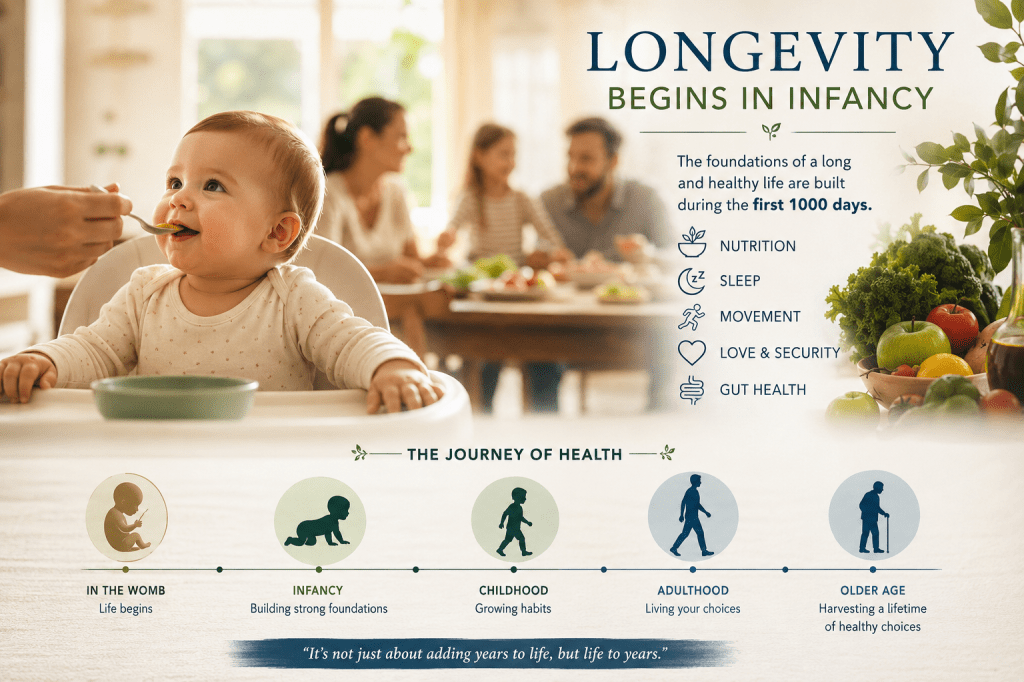
A Senior Child Development Specialist’s 41-Year Perspective on Infant Nutrition, Healthy Aging, Lifelong Health, and the First 1,000 Days
As a Senior Child Development Specialist with more than forty-one years of professional experience working with infants, children, adolescents, and families, I have observed firsthand how early-life nutrition and childhood experiences can shape health across the lifespan.
For the past several years, a new concept has captured global attention: longevity.
Longevity is not simply about living longer. It is about extending the number of healthy, active, and independent years of life. The goal is not merely to increase lifespan, but to increase healthspan—the years spent living free from major chronic disease, disability, and loss of function.
Increasingly, researchers are discovering that infant nutrition, the first 1,000 days of life, and early childhood experiences play a critical role in lifelong health, healthy aging, and longevity. What happens during pregnancy, infancy, and early childhood may influence health outcomes decades later.
Today, some of the world’s leading universities, research institutions, and healthcare organizations are investing heavily in longevity research. Scientists are exploring the roles of nutrition, physical activity, sleep, stress management, genetics, and lifestyle interventions in promoting healthy aging and extending lifespan.
As a result, millions of people are asking important questions:
What should we eat to live longer?
Which lifestyle habits support healthy aging?
How can we reduce the risk of chronic disease later in life?
Yet amid these discussions, one important fact is often overlooked:
Longevity does not begin in adulthood. Longevity begins in infancy.
A person’s future health is not determined solely by genetics. The foods consumed during the earliest years of life, the habits formed during childhood, growth patterns, sleep quality, physical activity, and family environment all have profound effects on long-term health outcomes.
Many people attempt to improve their health in their fifties, sixties, or even later. Some change their diets. Others begin exercising after retirement. These choices are valuable and can improve quality of life at any age.
However, the foundations of lifelong health are established much earlier.
In fact, if we look closely at the scientific evidence, the journey toward healthy aging begins even before birth.
Researchers in child development, pediatrics, nutrition science, and public health increasingly recognize that early life experiences influence health across the entire lifespan. A baby’s first foods, sleep patterns, gut health, opportunities for movement, and emotional environment can affect not only childhood well-being but also adult health decades later.
For this reason, longevity is not truly a new idea.
What is new is our growing scientific understanding of how early-life experiences shape lifelong health.
The foundations of a long and healthy life have always been built in the same place:
Infancy.
The Longevity Trend Is New—Its Foundation Is Not: Infant Nutrition
Books, podcasts, conferences, and research programs focused on longevity continue to grow in popularity. Adults are eager to learn which foods to eat, which exercises to perform, and which habits to adopt in order to live longer and healthier lives.
Yet the foundations of healthy aging are not established in adulthood.
They are established during the earliest stages of life.
The foods a baby receives, the development of the gut microbiome, sleep habits, movement opportunities, and early nutritional experiences all contribute to the health trajectory that follows.
While the word longevity may be relatively new, the principles that support it are not.
Healthy beginnings have always been one of humanity’s most powerful investments in lifelong health.
Many of the principles now promoted by longevity science have been practiced by families for generations, long before the term longevity became popular.
This is why I believe that longevity begins in infancy, not later in life.
Longevity Begins Before Birth
Looking for the roots of longevity only after birth provides an incomplete picture.
Modern science increasingly recognizes that life in the womb can influence future health outcomes in meaningful ways.
A mother’s nutrition, sleep quality, stress levels, and overall health can affect fetal development. During pregnancy, the developing baby is not only forming organs and body systems but also establishing biological patterns that may influence health later in life.
For this reason, the longevity journey does not begin on a person’s birthday.
Its earliest foundations are laid quietly during pregnancy.
Why Does Science Place So Much Importance on the First 1,000 Days?
One of the most influential concepts in modern health science is known as The First 1,000 Days.
This period spans from the beginning of pregnancy through a child’s second birthday.
Research shows that nutrition during this critical window affects far more than immediate growth and development. Early nutrition may also influence health outcomes decades later.
Scientists have linked early-life nutrition and developmental conditions to future cardiovascular health, metabolic health, immune system function, and certain aspects of healthy aging.
The concept of healthspan, which sits at the center of longevity research, is increasingly connected to the biological programming that occurs during these early years.
For this reason, many researchers now view the first 1,000 days as one of the most important windows of opportunity for promoting lifelong health and healthy aging.
As both a child development specialist and a family educator, I have witnessed these patterns repeatedly throughout my career. The scientific evidence emerging today often confirms observations I have made while working with thousands of children and families over four decades.
The Connection Between Early Nutrition, Healthy Aging, and Lifelong Health
Longevity researchers are no longer focused solely on old age.
Increasingly, they are examining the entire lifespan.
Scientific evidence suggests that inadequate or unbalanced nutrition during early life may lead to long-term biological changes that influence health decades later.
Some researchers describe this phenomenon as nutritionally programmed aging pathways.
In other words, aging does not begin at age sixty or seventy.
The biological foundations that influence how we age may begin forming during infancy and early childhood.
This is one reason why more longevity researchers are turning their attention to the earliest stages of life.
Developmental Programming: How the Body Prepares for the Future
Scientists today often speak about a concept known as developmental programming.
According to this concept, the human body begins recording information from its environment during the earliest stages of life. From life in the womb onward, the nutrients a baby receives, growth conditions, and environmental influences help shape biological systems that may affect health later in life.
A useful comparison is the foundation of a house. The quality of the foundation influences how well the building stands for decades to come. Human development works in a similar way. The foods consumed during early life do more than support growth in the present; they help establish biological systems that influence how the body functions in the future.
Research increasingly suggests that nutrition from pregnancy through early childhood may affect metabolism, immune function, hormonal regulation, and even aspects of the aging process. For this reason, childhood nutrition is no longer viewed solely through the lens of growth and development. It is increasingly recognized as an important contributor to lifelong health, healthy aging, and long-term healthspan.
Throughout my forty-one years of professional experience, I have shared one message with families again and again: a child’s body is not only growing for today—it is preparing for the future. Every nutritious meal is more than a meal for the moment; it is a small but meaningful investment in future health.
How Breastfeeding Supports Lifelong Health
Breast milk is far more than a source of infant nutrition.
It contains immune-supporting compounds, growth factors, enzymes, hormones, and hundreds of biologically active components that contribute to infant development.
Babies who receive breast milk during the first months of life are not only being nourished; they are also receiving important support for the development of their immune systems.
Breastfeeding helps establish a healthy gut microbiome, which plays a critical role in overall health.
Many of the topics now discussed in longevity research—including gut health and immune resilience—begin to take shape during the earliest months of life.
For this reason, breastfeeding should be viewed not only as nourishment for today, but also as an investment in future health.
Breastfeeding is one of the earliest nutritional influences on lifelong health, and its benefits may extend well beyond infancy into childhood and adulthood.
Food Preferences Are Learned, Not Born
Many parents wonder why their children dislike vegetables or seem to prefer sweets.
In reality, most food preferences are learned rather than inherited.
A newborn baby does not ask for soda.
A baby does not crave chocolate.
A baby does not seek brightly colored candies or ultra-processed snack foods.
These preferences develop over time through repeated exposure.
This is why the earliest years of life are so important.
When children are introduced to real foods from an early age, those foods become normal to them.
Vegetables become normal.
Yogurt becomes normal.
Eggs become normal.
Fish becomes normal.
Fruit becomes normal.
Children develop their taste preferences within the environment created by their families.
One of the hidden foundations of lifelong health is built during these early experiences with food.
Research suggests that early exposure to a wide variety of nutritious foods may help children develop healthier eating habits that last throughout life.
The Road to 100 May Begin in the High Chair
At first glance, this statement may sound ambitious.
Of course, no one can guarantee a specific lifespan.
However, we now understand that habits established during infancy can influence behavior for decades.
In many ways, this is where the idea that longevity begins in infancy becomes more than a slogan—it becomes a practical reality.
The foods a child encounters, the taste preferences they develop, and their relationship with eating may shape future health behaviors.
Every meal does more than satisfy hunger.
Every meal helps shape future habits.
For this reason, every healthy meal prepared by parents can be viewed as a quiet investment in a child’s future well-being.
The Gut Microbiome and Lifelong Health
One of the most fascinating areas of contemporary science is the study of the gut microbiome.
Trillions of microorganisms living within the human digestive system interact with multiple aspects of health, including digestion, immunity, metabolism, and brain function.
Research suggests that gut health may influence quality of life far more than previously understood.
This is one reason why nutrition during infancy and early childhood is so important.
Children who regularly consume real foods such as vegetables, fruits, legumes, and other nutrient-dense foods help support microbial diversity within the gut.
These foods provide more than vitamins and minerals; they also nourish beneficial gut bacteria.
Many adults searching for ways to improve their microbiome overlook one important fact:
The story of gut health begins in infancy.
A healthy gut microbiome established during early childhood may contribute to better healthspan, resilience, and overall well-being throughout life.
The Risks of Early Exposure to Added Sugars
A child is not born wanting sugary drinks.
A child is not born wanting candy.
These preferences are learned.
For this reason, one of the most important responsibilities of parents is introducing children to natural flavors before highly processed foods become familiar.
Frequent exposure to highly sweet foods during early childhood may influence taste preferences. Over time, naturally sweet fruits may seem less appealing, while vegetables may become more difficult to accept.
When raising my own children, I chose not to introduce them to sugary packaged foods, chewy candies, soft drinks, or heavily processed products.
My goal was never to create restrictions.
My goal was to help them appreciate the natural flavors of real foods.
Looking back today, I appreciate the value of that decision even more.
Today, many longevity researchers emphasize the importance of reducing excessive added sugar consumption. In my experience, helping children develop a preference for natural foods early in life may be one of the simplest and most sustainable ways to support lifelong healthy eating habits.
The eating habits established during childhood often influence food choices for years to come. For this reason, introducing children to real foods early in life may be one of the most valuable investments families can make in lifelong health and healthy aging.
Why Protein Matters for Lifelong Health and Healthy Aging
One of the most discussed topics in modern longevity research is muscle health.
Strong muscles are important not only during youth but also for maintaining independence later in life.
However, strong muscles are not built at age sixty.
Their foundations are established much earlier.
Adequate protein intake, regular physical activity, and healthy growth patterns play important roles throughout life.
When I think about my own childhood, I remember that protein-rich foods were always central to our family meals.
Meat, fish, eggs, yogurt, and home-cooked meals were everyday staples.
As modern science continues to emphasize the importance of muscle health and healthy aging, we are beginning to recognize the wisdom behind many traditional nutritional practices.
Maintaining muscle mass is increasingly recognized as one of the strongest predictors of healthy aging, mobility, and independence later in life. The foundations of muscle health are established much earlier than most people realize.
From a longevity perspective, preserving muscle mass is not simply about strength—it is about maintaining function, independence, and quality of life as we age.
Why Sleep Matters for Child Development and Healthy Aging
Many families pay close attention to nutrition while unintentionally overlooking sleep.
Yet sleep is essential for healthy growth and development.
Growth hormone is primarily released during sleep.
The brain processes and organizes new learning during sleep.
The immune system restores itself.
Cells undergo repair and recovery.
Children who do not receive adequate sleep may experience challenges not only with energy levels but also with healthy development.
For this reason, lifelong health and healthy aging are shaped not only by what is on the plate, but also by what happens during the night.
Active Children, Healthy Aging
Children are designed to move.
Running, jumping, climbing, balancing, and playing are natural parts of healthy child development.
Unfortunately, modern lifestyles are gradually reducing opportunities for movement. Increased screen time, fewer outdoor play experiences, and more sedentary routines are affecting children’s physical health and development.
Movement is about far more than burning calories.
It supports muscle development.
It strengthens bones.
It improves balance and coordination.
It builds confidence and resilience.
Many of the habits that contribute to healthy aging later in life begin during childhood. Encouraging children to move freely, play actively, and enjoy physical activity may be one of the most valuable investments in lifelong health.
Regular physical activity during childhood helps establish movement habits that can support healthspan, physical function, and overall well-being throughout adulthood.
Raising Children in the Digital Age
Today’s children are growing up in one of the most digitally connected generations in human history.
Screens are present in nearly every aspect of daily life.
Technology can certainly make life easier.
However, it cannot replace the fundamental needs of child development.
A screen can never replace real play.
An app can never replace parental love.
A video can never replace time spent outdoors.
From a longevity perspective, children need real-life experiences.
Real play.
Real movement.
Real relationships.
Real food.
These experiences help build the physical, emotional, and social foundations that support lifelong health and well-being.
In a world increasingly shaped by technology, these real-life experiences remain essential for healthy child development and lifelong health.
Family Meals and the Foundations of Longevity
Longevity is not only about what we eat.
It is also about how we eat.
For previous generations, family meals were often at the center of daily life.
Meals were not simply about satisfying hunger.
They were opportunities for connection.
Children learned patience.
They learned conversation.
They learned sharing.
Family meals strengthened relationships while creating routines that supported both emotional and physical well-being.
Today, longevity researchers consistently emphasize the importance of social connection in healthy aging.
Perhaps one of the most overlooked secrets of longevity is not only what we eat, but also who we share our meals with.
A Personal Story: What My Own Childhood Taught Me About Longevity
My belief that the foundations of lifelong health are established early in life is based not only on professional experience but also on my own personal story.
When I was growing up, my father regularly gave my brother and me fish oil, long before it became widely known as omega-3. At the time, it was simply called fish oil.
Looking back, I now realize that many of the habits associated with healthy aging, lifelong health, and longevity were part of my childhood long before these concepts became widely discussed.
The primary fats used in our home were butter and extra virgin olive oil.
Our family meals centered around real, home-cooked foods.
Meat, fish, eggs, yogurt, and protein-rich meals were everyday staples.
Highly processed foods were not part of our family culture.
Today, I find it fascinating that many of the practices my family followed are now being discussed in modern longevity research.
At that time, no one talked about longevity.
No one calculated omega-3 indexes.
No one discussed the gut microbiome.
Yet many families understood the value of real food.
Perhaps the terminology has changed, but the underlying principles remain the same.
The foundation of health is still built on nourishing, natural foods.
Today, at the age of 63, I appreciate those early lessons more than ever.
Of course, no single food or habit determines a person’s health outcomes. However, I firmly believe that the habits established during childhood can influence health throughout life.
Growing up with real food, regular family meals, and simple nutritional principles gave me a strong foundation.
Perhaps this is one reason I have reached the age of 63 without experiencing major health problems.
Today, I follow developments in longevity science with great interest. In many ways, I find myself rediscovering through modern research the nutritional culture that shaped my childhood decades ago.
The more I learn about longevity science, the more I recognize connections between modern research and the lessons I have learned throughout my professional life.
Perhaps one reason longevity has become such a meaningful subject to me is the nature of my profession itself.
For more than forty-one years, I have worked with babies, children, adolescents, and families. When you spend a lifetime helping children grow, you naturally learn to look beyond the present moment. You begin to think about the future. Every meal, every habit, every experience becomes part of a much larger story.
Children teach us something valuable: growth never truly stops. Curiosity remains one of the most powerful forces in human development. After four decades in child development and family education, I sometimes feel that I still carry a small part of that childlike curiosity within me.
Perhaps that is why I continue to follow new discoveries in longevity science with such enthusiasm. The desire to learn, to grow, and to keep exploring may be one of the healthiest habits we can carry throughout life.
What Forty-One Years of Professional Experience Have Taught Me
For more than forty-one years, I have worked with infants, children, adolescents, and families. Throughout my career, I have had the opportunity to observe tens of thousands of children and parents from diverse backgrounds, educational levels, and lifestyles.
One observation has remained remarkably consistent.
The families who seemed to thrive over the long term were rarely those chasing quick fixes. More often, they were the families who consistently practiced simple, sustainable habits centered around nutrition, movement, sleep, and connection.
Children and families who regularly consume balanced amounts of protein, vitamins, minerals, healthy fats, and other essential nutrients tend to experience fewer health challenges than those whose diets are inadequate, highly restricted, or heavily dependent on nutrient-poor foods.
I am not referring to a single vitamin, supplement, or miracle food.
The human body is an extraordinary system that depends on a wide range of nutrients working together. Proteins provide the building blocks for growth and repair. Vitamins and minerals support countless biochemical processes. Healthy fats contribute to brain development, cellular function, and energy production. Fiber supports digestive health, while water remains essential for every system in the body.
One of the most important lessons I have learned is that a full stomach does not always mean a well-nourished body.
Many children consume enough calories while still lacking essential nutrients needed for healthy growth, immune function, and cognitive development.
Throughout my career, the healthiest children I encountered did not rely on miracle products or trendy supplements.
More often, they shared several common characteristics:
They ate regular family meals.
They were introduced to vegetables and fruits early in life.
They consumed adequate sources of protein.
They grew up eating home-cooked meals and a variety of real foods.
The same pattern was often visible among parents. Families who embraced balanced nutrition as part of their lifestyle frequently demonstrated better overall health, higher energy levels, and greater quality of life.
Today, longevity research emphasizes the importance of nutrition as a cornerstone of healthy aging.
I have spent more than four decades observing its real-life impact.
No nutritional approach can guarantee perfect health or prevent every disease.
However, I have repeatedly seen that children who are well nourished tend to begin life with important advantages.
For this reason, I often tell families:
Nutrition is not only about today’s meal.
Nutrition is an investment in future health.
Every meal contributes quietly to a child’s immune system, brain development, physical growth, and future quality of life.
Perhaps one of the strongest foundations of longevity is built around the family table.
Many of the findings now emerging from laboratories and scientific journals are reflections of patterns I have observed throughout my professional life.
After observing tens of thousands of children and families, I have become convinced that longevity begins in infancy.
For this reason, I no longer view longevity as a subject that begins in old age.
To me, longevity is not primarily about how long we live.
It is about how we begin.
And that beginning is often found in a baby’s first spoonful of food, the first family meal, and the earliest years of life.
Conclusion
Across the world, people are searching for ways to live longer.
New supplements are introduced.
New diets are promoted.
New longevity strategies are discussed.
Yet one of the most important secrets of lifelong health is remarkably simple.
Healthy beginnings.
Nurturing care during pregnancy.
Breastfeeding when possible.
A positive relationship with real foods.
Delayed exposure to added sugars.
Quality sleep.
Active childhoods.
Strong family relationships.
Love, security, and connection.
None of these factors alone can guarantee a long life.
However, together they help build a stronger foundation for lifelong health and healthy aging.
The ultimate goal of longevity is not simply a longer lifespan, but a longer healthspan—the ability to remain healthy, active, and independent for as many years as possible.
Perhaps the most important question is not how long we can live.
Perhaps the more important question is:
When does longevity begin?
The growing fields of longevity science, infant nutrition, child development, preventive health, and healthy aging are increasingly pointing toward the same conclusion: the foundations of healthspan and lifelong well-being are established far earlier than most people realize.
After forty-one years of professional experience, my own life journey, and the growing body of scientific evidence, my answer remains the same:
Longevity begins in infancy.
Healthy aging begins in infancy.
Lifelong health begins in infancy.
Healthy aging is not only about how the body ages.
It is about ensuring that curiosity, growth, and the desire to learn never grow old.
“If I am going to live to 140, I want to be healthy enough to keep writing articles at 140.”
Rabia Gürer Gürkan
Senior Child Development Specialist
41+ years of professional experience in family education
References
- Barker DJ. Foundational research on the Developmental Origins of Health and Disease (DOHaD).
- World Health Organization (WHO). Infant and Young Child Feeding Fact Sheet. 2023.
- Alves JGB. Early-Life Nutrition and Adult-Life Outcomes. 2023.
- Vaiserman AM. Early-Life Nutritional Programming of Longevity. Journal of Developmental Origins of Health and Disease, 2014.
- Tarry-Adkins JL, Ozanne SE. The Impact of Early Nutrition on the Ageing Trajectory. Proceedings of the Nutrition Society.
- Ren H. Nutrition in Early Life and Its Impact Through the Life Course. Nutrients, 2025.
- Godfrey K. Nutrition in Early Life, Epigenetics, and Lifelong Health. 2025.
- Xu A. et al. Nutrition Interventions in the First 1,000 Days and Long-Term Health Outcomes: A Systematic Review. Pediatric Research, 2025.
Tags: Longevity, Healthy Aging, Healthspan, Infant Nutrition, First 1000 Days, Child Development, Lifelong Health, Early Childhood Development, Preventive Health, Family Education

