
Rabia Gürer Gürkan
Senior Child Development Specialist
41+ years of professional experience in family education
Introduction
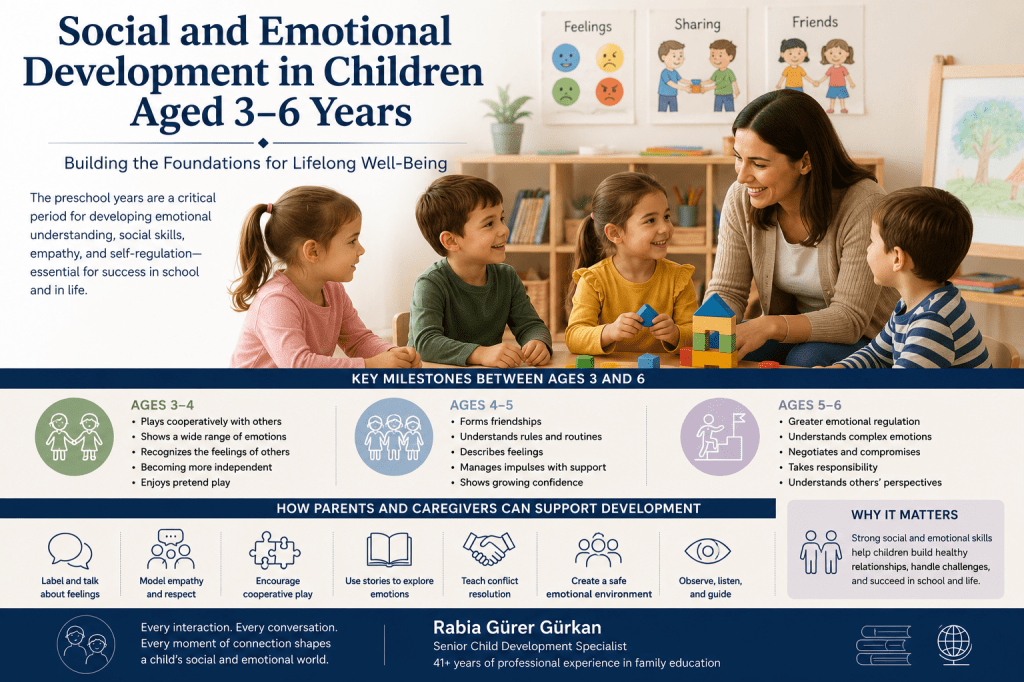
The preschool years, encompassing ages 3 to 6, are a period of remarkable growth in children’s social and emotional development. During this time, children not only form deeper relationships with peers and adults but also begin to understand their own emotions and those of others. This developmental domain plays a critical role in preparing children for future academic success, mental well-being, and meaningful interpersonal relationships. In this article, we will explore the key components of social and emotional development in early childhood, the factors that influence it, and how parents and caregivers can foster healthy development in this area.
Throughout more than forty-one years of working with children and families, I have observed that social and emotional development often influences a child’s daily life as much as cognitive or academic skills. A child who can understand emotions, build relationships, cope with frustration, and communicate effectively is often better equipped to navigate the challenges of school, friendships, and later adult life.
While every child develops at their own pace, the preschool years represent one of the most important periods for building the social and emotional foundations that support lifelong well-being.
Understanding Social and Emotional Development
Social development refers to the child’s ability to form and maintain relationships with others. This includes skills such as cooperation, sharing, empathy, and conflict resolution. Emotional development, on the other hand, pertains to the child’s ability to understand, express, and regulate emotions in socially appropriate ways. These two domains are deeply intertwined and essential for navigating the social world effectively.
Milestones in Social and Emotional Development (Ages 3–6)
Ages 3–4:
- Begins to play cooperatively with other children.
- Shows a wide range of emotions.
- Develops basic empathy by recognizing the feelings of others.
- Becomes more independent in daily activities.
- Enjoys pretend play and role-playing social scenarios.
Ages 4–5:
- Forms friendships and shows preference for certain playmates.
- Understands rules and routines.
- Can describe their own feelings and those of others.
- Begins to manage impulses and frustrations with some support.
- Demonstrates growing confidence in social settings.
Ages 5–6:
- Displays greater emotional regulation and patience.
- Understands complex emotions such as guilt, jealousy, and pride.
- Negotiates and compromises during play.
- Takes responsibility for their actions.
- Begins to understand the perspective of others.
Influential Factors in Social and Emotional Development
- Parenting Style: Warm, responsive, and consistent parenting is associated with positive outcomes in emotional regulation and social competence. Authoritative parenting, in particular, fosters autonomy while setting clear expectations.
- Attachment Quality: Secure attachment to caregivers provides a foundation for trusting relationships and emotional security. Attachment theory (Bowlby, 1969; Ainsworth, 1978) highlights how early interactions with caregivers shape future emotional and social development.
- Modeling and Social Learning: Children learn by observing and imitating the behavior of adults and peers. When caregivers model empathy, conflict resolution, and emotional expression, children are more likely to adopt these behaviors. In my professional experience, children often learn more from what adults do than from what adults say. Parents who model empathy, patience, respectful communication, and emotional regulation provide some of the most powerful lessons in social and emotional development.
- Early Childhood Education: Preschool environments that promote social interaction, cooperative play, and emotional literacy support the development of social-emotional skills.
- Cultural and Societal Context: Cultural norms and values influence how emotions are expressed and managed. Children learn the emotional “rules” of their culture through interactions with family and community.
- Temperament: Children have innate differences in reactivity and self-regulation. Understanding a child’s temperament can help tailor strategies to support their emotional needs.
Strategies for Supporting Social and Emotional Development
- Foster Secure Attachments: Consistently responding to a child’s emotional needs builds a secure base for exploring the world.
- Label Emotions: Use everyday situations to help children name and understand their feelings (e.g., “I see you’re feeling frustrated because the game isn’t going your way”).
- Encourage Empathy: Discuss others’ feelings and encourage children to consider different perspectives.
- Model Healthy Relationships: Demonstrate respect, active listening, and problem-solving in your own interactions.
- Promote Play: Engage in and encourage pretend play, which allows children to explore social roles and practice emotional expression.
- Use Books and Stories: Reading books that address emotions and social situations helps children relate to characters and discuss feelings.
- Teach Conflict Resolution: Guide children through steps to resolve disputes, such as identifying the problem, expressing feelings, brainstorming solutions, and choosing a fair outcome.
- Create a Safe Emotional Environment: Ensure that the child feels safe to express all emotions without fear of judgment or punishment.
The Role of Educators and Caregivers
Teachers and caregivers are vital in reinforcing social and emotional learning. Structured activities like circle time, role-playing, and group discussions on emotions can enhance awareness and skills. Moreover, providing feedback and support during peer interactions helps children navigate challenges and develop resilience.
Programs such as the Collaborative for Academic, Social, and Emotional Learning (CASEL) highlight the importance of integrating SEL (social-emotional learning) into early childhood curricula. SEL programs have been shown to improve emotional competence, reduce behavioral problems, and increase academic performance (Durlak et al., 2011).
Warning Signs of Delays in Social and Emotional Development
While development varies from child to child, some signs may indicate the need for further assessment:
- Consistent difficulty in making or keeping friends.
- Extreme emotional reactions disproportionate to the situation.
- Persistent sadness, withdrawal, or aggression.
- Lack of interest in social interactions or play.
- Difficulty understanding or expressing emotions.
If caregivers notice these behaviors, consulting a pediatrician or child development specialist is recommended. Early intervention can significantly improve outcomes.
Conclusion
Social and emotional development in the 3–6 age range sets the stage for a child’s future well-being, academic success, and interpersonal relationships. By understanding typical milestones, recognizing the impact of various environmental and personal factors, and applying intentional strategies, parents and educators can provide meaningful support during this foundational period. Promoting empathy, emotional literacy, and social competence helps children grow into emotionally healthy, socially aware individuals.
After more than forty-one years of working with children, adolescents, and families, I remain convinced that social and emotional development deserves the same attention we give to academic learning.
Children who learn to understand their feelings, build healthy relationships, show empathy, and manage challenges are developing skills that will serve them throughout life.
The preschool years are not simply a preparation for school. They are a preparation for life.
When adults provide love, security, guidance, and opportunities for social learning, they help children build the emotional foundations for lifelong well-being and healthy relationships.
References
- Ainsworth, M. D. S., Blehar, M. C., Waters, E., & Wall, S. (1978). Patterns of attachment: A psychological study of the strange situation. Hillsdale, NJ: Erlbaum.
- Bowlby, J. (1969). Attachment and loss: Vol. 1. Attachment. New York: Basic Books.
- Durlak, J. A., Weissberg, R. P., Dymnicki, A. B., Taylor, R. D., & Schellinger, K. B. (2011). The impact of enhancing students’ social and emotional learning: A meta‐analysis of school‐based universal interventions. Child Development, 82(1), 405–432.
- Denham, S. A., Bassett, H. H., Zinsser, K., & Wyatt, T. M. (2014). How preschoolers’ social–emotional learning predicts their early school success: Developing theory‐promoting, competency‐based assessments. Infant and Child Development, 23(4), 426–454.
- National Scientific Council on the Developing Child (2004). Children’s emotional development is built into the architecture of their brains. Center on the Developing Child, Harvard University.
- Collaborative for Academic, Social, and Emotional Learning (CASEL). (2023). Retrieved from https://casel.org
Tags: Social and Emotional Development, Preschool Development, Early Childhood Development, Emotional Development, Social Development, Emotional Regulation, Child Behavior, Child Development, Parenting, Family Education

