
Rabia Gürer Gürkan
Senior Child Development Specialist
41+ years of professional experience in family education
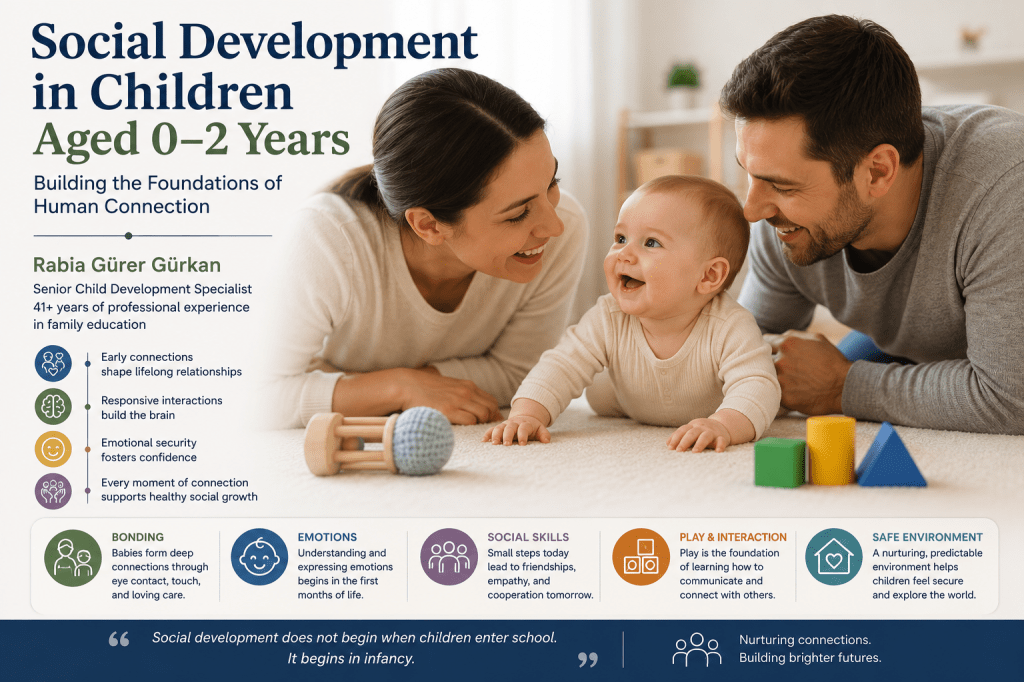
Throughout more than forty-one years of working with infants, young children, and families, I have observed that social development begins much earlier than many adults realize. Long before children learn to speak in full sentences, they are already building relationships, reading emotional cues, and learning how to connect with the people around them.
Many parents assume that social skills begin when children enter preschool. In reality, the foundations of social development are established from the very first days of life through eye contact, touch, responsive caregiving, and everyday interactions.
This article explores how social development unfolds during the first two years of life and why these early experiences play such an important role in shaping future relationships, emotional well-being, and lifelong social competence.
Introduction
Human beings are inherently social. From the moment a baby is born, they seek connection—with caregivers, voices, touch, eye contact, and later, shared emotions and social rules. Social development in the first two years of life refers to how babies begin to understand themselves in relation to others, develop trust, learn empathy, and lay the groundwork for friendships, cooperation, and emotional regulation.
This article explores the science behind social development in infants and toddlers aged 0–24 months. With insights from child psychology, pediatrics, neuroscience, and global early childhood research, it offers a practical and evidence-based guide for families and professionals worldwide. It is structured for SEO performance and designed to rank highly across global platforms.
What Is Social Development?
Social development in the first two years involves:
- Recognizing and bonding with caregivers
- Expressing and responding to emotions
- Understanding social cues (e.g., smiling, tone of voice)
- Developing a sense of self and others
- Beginning social play and cooperation
These early social behaviors are closely tied to emotional development, and together they form the basis for future relationships, identity, and mental health.
Developmental Milestones by Age
Based on CDC, WHO, and Harvard Center on the Developing Child guidelines:
0–3 Months
- Responds to voice and touch
- Smiles in response to social interaction
- Begins to mimic facial expressions
4–6 Months
- Laughs out loud
- Enjoys peek-a-boo and similar games
- Turns to familiar voices
7–9 Months
- Shows attachment to caregivers
- Develops stranger anxiety
- Tries to attract attention with gestures or sounds
10–12 Months
- Engages in joint attention (looking where adult points)
- Waves “bye-bye,” claps
- Seeks comfort when upset
13–18 Months
- Imitates adult behaviors
- Shows empathy (e.g., concerned when others cry)
- Plays alongside others (parallel play)
19–24 Months
- Shows preference for familiar people
- Engages in pretend social play (feeding a doll)
- Begins cooperative play with peers
The Science of Attachment
Attachment theory, developed by John Bowlby and expanded by Mary Ainsworth, emphasizes that a secure emotional bond with a primary caregiver is the cornerstone of healthy social development.
- Securely attached babies feel safe exploring the world because they trust their caregiver will return.
- Insecure attachment (from neglect, inconsistency, or trauma) can lead to anxiety, fearfulness, or withdrawal.
Research shows secure attachment leads to:
- Better emotion regulation
- Stronger peer relationships
- Higher self-confidence
(National Scientific Council on the Developing Child, 2022)
Role of Caregivers in Social Development
Responsive caregiving is crucial. Parents and caregivers can support social development by:
- Making eye contact during feedings and diaper changes
- Talking through emotions (“You look sad—do you want a hug?”)
- Modeling positive interactions with others
- Offering consistent routines to build trust and predictability
In global research, “serve-and-return” interactions—where babies gesture or vocalize and adults respond—are shown to stimulate brain regions linked to social understanding.
Emotions in the First Two Years
Babies begin life with basic emotional reactions (comfort/discomfort), but their emotional range expands rapidly:
- By 6 months: Joy, surprise, anger, fear
- By 12 months: Embarrassment, jealousy
- By 24 months: Guilt, shame, pride
Social development includes learning how to express and respond to emotions appropriately, a process called emotional regulation.
Cultural and Environmental Influences
Social behavior is shaped by culture. Examples:
- In Japan, babies are encouraged to be quiet and socially aware.
- In the U.S., independence and assertiveness are emphasized.
- African and Latin American cultures may stress extended-family bonds and group play.
However, secure, responsive care is universally beneficial.
Red Flags in Social Development
Watch for signs that may indicate delays or social-emotional concerns:
- No social smile by 3 months
- Lack of eye contact by 6 months
- No response to name by 12 months
- Doesn’t show interest in others by 18 months
- Doesn’t engage in pretend play by 24 months
If concerns arise, early intervention (such as speech therapy, child psychology, or parenting programs) is highly effective.
Social Play and Its Evolution
Play is how babies learn social rules.
Types of play in early years:
- Solitary play (0–12 months): Babies play alone but observe others
- Parallel play (12–24 months): Play alongside others without interaction
- Associative and cooperative play (emerges after 24 months)
Caregivers can support play by:
- Providing diverse toys (puppets, dolls, mirrors)
- Organizing safe playdates
- Playing interactive games like peek-a-boo and pat-a-cake
Social Impact of Siblings and Peers
Siblings and peers introduce babies to:
- Sharing and turn-taking
- Dealing with conflict
- Learning social norms and language
Even negative interactions (e.g., toy grabbing) can teach important social skills—if guided appropriately.
Screens, Social Isolation, and Pandemic Effects
Recent years have raised new questions:
- Too much screen time in infancy can reduce face-to-face social learning (AAP, 2023).
- Babies born during the COVID-19 pandemic showed delayed social milestones due to isolation (Nature, 2021).
Recommendations:
- Limit screens under 18 months
- Prioritize real-life interaction
- Use video calls meaningfully with distant family members
Activities to Support Social Development
0–6 Months
- Skin-to-skin contact
- Mimic faces and sounds
- Smile and speak often
7–12 Months
- Mirror games
- Pointing and naming objects
- “Where’s mommy?” games
13–18 Months
- Pretend feeding stuffed animals
- Peek-a-boo with peers
- Dancing to music together
19–24 Months
- Role play (doctor, parent)
- Storytelling with expression
- Cooperative building (e.g., towers)
Conclusion
Social development in the first two years sets the stage for a child’s emotional health, relationships, empathy, and sense of self. From warm eye contact to guided play, every moment of responsive care helps babies grow into emotionally intelligent, connected human beings. For parents and caregivers, these years are an opportunity not just to raise a child—but to shape the future of human empathy.
After more than four decades of working with children and families, I remain convinced that some of the most important moments in social development are often the simplest.
A warm smile.
A comforting touch.
A responsive conversation.
A shared moment of play.
These everyday interactions may seem small, yet they help build the foundations of trust, empathy, emotional security, and human connection.
Social development does not begin when children enter school.
It begins in infancy.
References
- American Academy of Pediatrics (AAP). (2023). Screen Time and Social-Emotional Development.
- Bowlby, J. (1969). Attachment and Loss.
- CDC (2023). Social and Emotional Milestones.
- Harvard University – Center on the Developing Child. (2022). Serve and Return Interactions.
- National Scientific Council on the Developing Child. (2022). The Science of Early Childhood Development.
- Nature. (2021). Pandemic and Infant Social Development.
- WHO. (2022). Nurturing Care for Early Childhood Development.
Tags: Infant Social Development, Toddler Development, Social Development, Early Childhood Development, Child Development, Attachment Theory, Infant Milestones, Social and Emotional Development, Responsive Parenting, Family Education
 Rabia Gürer Gürkan – Senior Child Development Specialist | 41+ Years of Experience in Child & Family Education