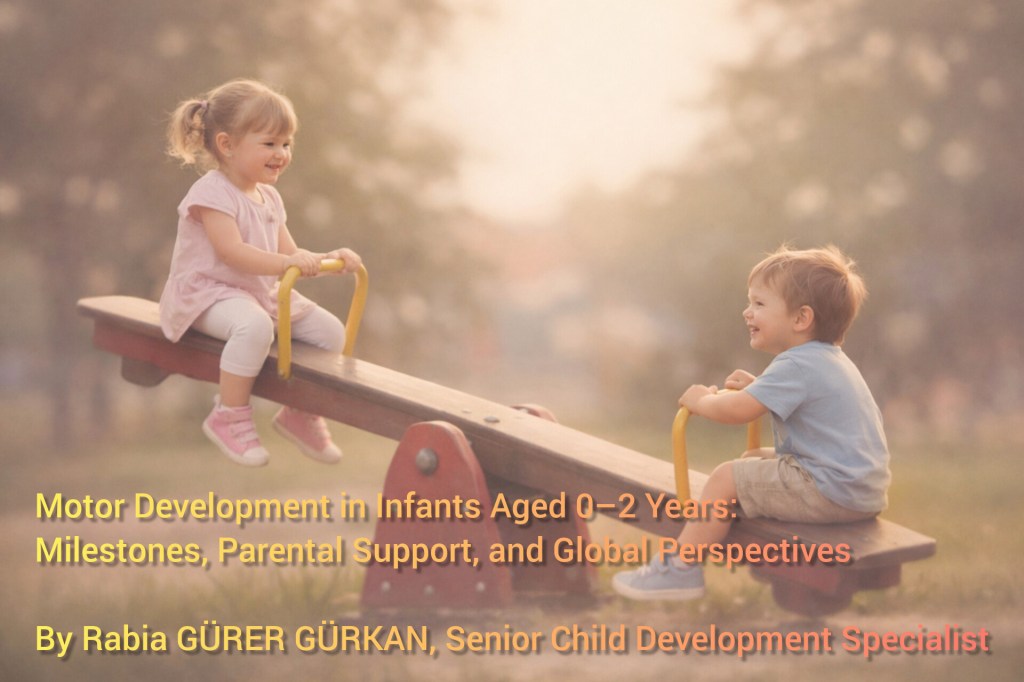
By Rabia GÜRER GÜRKAN, Senior Child Development Specialist
Motor development is one of the most visible and measurable aspects of early childhood growth. Between birth and age two, children undergo rapid changes in strength, coordination, and mobility, forming the foundation for independence and learning. Understanding this process is crucial for parents, caregivers, and professionals supporting infants during these critical years.
What Is Motor Development?
Motor development refers to the progression of muscular coordination required for physical activities. It includes both:
Gross motor skills: large movements (e.g., sitting, crawling, walking)
Fine motor skills: small, precise movements (e.g., grasping, pointing)
These skills evolve through dynamic interaction between the infant’s biology and environment.
Gross vs. Fine Motor Skills: Definitions and Examples
Type Examples Importance
Gross Motor Lifting head, rolling, crawling, walking Mobility, posture, exploration
Fine Motor Holding a rattle, finger feeding, stacking blocks Object manipulation, self-care
Motor Milestones from 0–24 Months
0–3 Months
Lifts head briefly while on tummy
Hands open more often
Kicks legs in bicycle motion
4–6 Months
Rolls over
Pushes up with arms during tummy time
Reaches and grasps for toys
7–9 Months
Sits without support
Begins to crawl or scoot
Transfers objects hand-to-hand
10–12 Months
Pulls to stand
Cruises along furniture
Pincer grasp (thumb and forefinger)
13–18 Months
Begins to walk independently
Scribbles with crayons
Feeds self with fingers
19–24 Months
Runs, climbs stairs with help
Builds tower of 4+ blocks
Starts using utensils
Factors Influencing Motor Development
Genetics: Some children naturally develop faster due to hereditary traits.
Nutrition: Adequate intake of iron, calcium, omega-3s, and proteins is vital.
Sleep: Proper rest promotes neural connections that influence coordination.
Environment: Safe spaces and encouragement foster practice and movement.
Cultural practices: Swaddling, floor time, babywearing impact motor milestones.
The Role of Parents and Caregivers
Parents play a crucial role by:
Providing safe and stimulating environments
Encouraging tummy time from birth
Celebrating progress, not perfection
Offering age-appropriate toys
Avoiding overuse of restrictive devices (e.g., bouncers, walkers)
Cross-Cultural Perspectives on Motor Development
Research shows cultural norms affect motor progression. For example:
African infants often reach milestones earlier due to more physical stimulation.
Western infants may experience slower gross motor growth due to extensive use of carriers and swings.
Indigenous communities often integrate infants into daily routines, supporting motor skills through natural interaction.
Early Warning Signs of Delay
Parents should consult a pediatrician if:
*By 6 months: Infant doesn’t roll over or reach for objects
*By 12 months: Not crawling or standing with support
*By 18 months: Not walking or exploring with hands
*Any noticeable asymmetry in movement or lack of interest in surroundings
At-Home Activities to Boost Motor Development
0–6 Months: Tummy time mats, soft rattles, mirror play
6–12 Months: Crawl tunnels, push toys, stacking cups
12–24 Months: Obstacle courses, ride-on toys, large crayons
> Encourage outdoor play and avoid prolonged screen time.
Conclusion
Motor development during the first two years of life represents far more than physical movement; it is a cornerstone of overall child development. Every roll, reach, crawl, and step reflects the integration of neurological maturation, emotional security, environmental opportunity, and responsive caregiving. In this critical period, motor skills do not develop in isolation but are deeply interconnected with cognitive growth, language acquisition, self-regulation, and social engagement.
It is essential to recognize that motor milestones follow a broad developmental range rather than a rigid timeline. Variations in pacing are normal and influenced by genetics, culture, caregiving practices, and daily experiences. What matters most is not how early a child achieves a milestone, but whether development is progressing steadily within a supportive and stimulating environment.
Parents and caregivers serve as the primary facilitators of motor development. By offering safe spaces for exploration, allowing freedom of movement, and responding sensitively to the child’s cues, adults create the conditions in which motor competence can naturally emerge. Equally important is avoiding excessive comparison, unnecessary pressure, or reliance on restrictive equipment that limits spontaneous movement.
Early identification of potential delays, combined with informed and timely professional guidance, can significantly improve developmental outcomes. Observant, educated caregivers are often the first to notice subtle signs that warrant further evaluation, underscoring the importance of parental awareness and evidence-based knowledge.
Ultimately, nurturing motor development in infancy is an investment in a child’s future independence, confidence, and capacity to engage with the world. When movement is supported with patience, respect, and understanding, children are empowered to build not only physical skills, but also resilience, curiosity, and a strong foundation for lifelong learning.
Scientific References
Adolph, K. E., & Hoch, J. E. (2018). Motor Development: Embodied, Embedded, Enculturated, and Enabling. Annual Review of Psychology, 69, 129–153.
World Health Organization (2023). Nurturing Care for Early Childhood Development.
Super, C. M., & Harkness, S. (1986). The Developmental Niche: A Conceptualization at the Interface of Child and Culture. International Journal of Behavioral Development, 9(4), 545–569.
American Academy of Pediatrics (2022). Motor Deve
 Rabia Gürer Gürkan – Senior Child Development Specialist