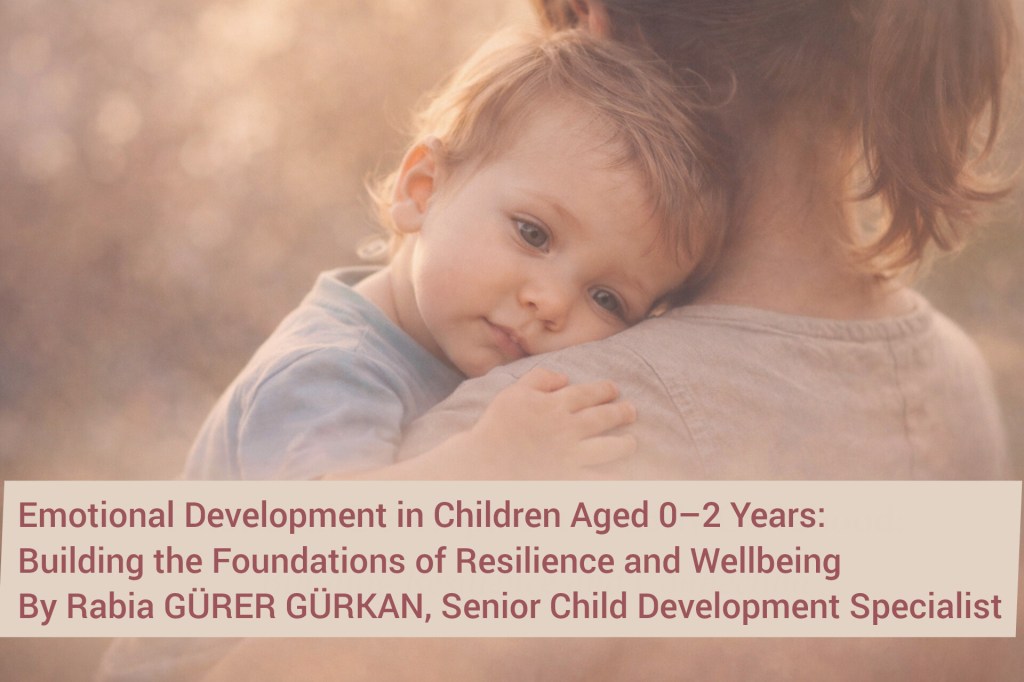
By Rabia GÜRER GÜRKAN, Senior Child Development Specialist
Emotions are the heartbeat of human experience. For infants and toddlers aged 0 to 2 years, emotional development is the gateway to healthy relationships, learning, self-awareness, and future mental health. These early years are a period of rapid brain development, where the foundations of emotional regulation, attachment, and empathy are formed through interactions with caregivers and the environment.
This article delves into the scientific, psychological, and developmental aspects of emotional growth in the first 24 months of life, guided by insights from the American Academy of Pediatrics (AAP), WHO, Harvard Center on the Developing Child, and other global authorities.
Section 1: What Is Emotional Development in Infancy?
Emotional development refers to the process by which babies learn to:
Recognize and express emotions
Understand the emotions of others
Regulate their emotional responses
Form emotional connections and trust
These skills begin developing from birth and influence all other domains of development, including cognitive, social, and language skills.
Section 2: The Biology Behind Infant Emotions
A baby’s emotional system is deeply rooted in the developing brain, particularly the limbic system, which includes the amygdala (processing fear and pleasure) and the prefrontal cortex (emotional regulation).
Research shows that responsive caregiving influences the development of neural pathways responsible for:
Emotional control
Stress response (cortisol regulation)
Future behavior and attention
(Harvard Center on the Developing Child, 2023)
Section 3: Emotional Milestones by Age
Birth to 3 Months
Expresses distress through crying
Calms with soothing touch or voice
Begins to smile socially
4 to 6 Months
Laughs and shows excitement
Responds to caregiver’s emotions
Soothes with routines and comfort
7 to 9 Months
Shows stranger anxiety
Reacts strongly to emotional tone
Begins seeking comfort from familiar people
10 to 12 Months
Displays fear, anger, and joy
Looks to caregivers for emotional cues (social referencing)
Demonstrates separation anxiety
13 to 18 Months
Expresses jealousy or frustration
Begins to show self-conscious emotions like embarrassment
Can be calmed with verbal reassurance
19 to 24 Months
Uses simple words to express feelings (“sad,” “mad”)
Starts showing empathy (“hugging” a crying friend)
Demonstrates pride and shame
Section 4: The Role of Attachment in Emotional Security
Emotional development is rooted in secure attachment—the emotional bond between a baby and primary caregiver. Developed by Bowlby and Ainsworth, attachment theory explains that:
Securely attached children use caregivers as a secure base to explore the world.
Insecure or disorganized attachment can result in emotional instability or anxiety.
Ainsworth’s Strange Situation Experiment showed that securely attached babies are:
More resilient in unfamiliar settings
Better at regulating stress
More socially confident
(Ainsworth, 1978; National Scientific Council on the Developing Child, 2022)
Section 5: Emotional Regulation in the First Two Years
Emotional regulation—the ability to manage one’s emotional responses—emerges gradually.
0–12 months: Babies rely completely on caregivers for regulation. Holding, soothing, swaddling, and gentle talking help calm them.
12–24 months: Toddlers begin self-regulating with support. They may:
Hug a toy for comfort
Seek a parent when upset
Use simple coping phrases (“All done!”)
Encouraging predictable routines, calm reactions, and labeling feelings helps strengthen emotional control.
Section 6: Emotion Coaching for Parents and Caregivers
Emotion coaching means helping babies recognize, understand, and manage emotions. Effective strategies include:
Naming feelings: “You’re sad because your toy broke.”
Validating: “It’s okay to feel frustrated.”
Modeling calm responses: Deep breaths, patience
Creating a safe environment: Emotional safety leads to risk-taking and growth
Emotionally attuned parenting is shown to reduce behavioral issues and support long-term wellbeing (Gottman, 2011).
Section 7: Cultural Variations in Emotional Expression
Emotional norms differ across cultures:
In Scandinavian countries, calmness and self-control are emphasized.
In Latin American cultures, emotional expressiveness is encouraged.
East Asian parenting often promotes emotional restraint and social harmony.
Despite cultural variations, responsive and consistent caregiving supports emotional health across all societies.
Section 8: Red Flags in Emotional Development
While emotional expression varies, the following may signal a delay or concern:
Rarely smiles or shows joyful expressions (by 6 months)
Doesn’t respond to comforting (by 9 months)
Shows extreme fear or irritability (persistently)
Lacks empathy or interest in others (by 24 months)
In such cases, early screening and developmental assessment are recommended.
Section 9: Impact of Screen Time and Environment
Excessive screen exposure can limit emotional learning by reducing face-to-face interactions. Pediatricians recommend:
No screen time under 18 months, except video calls
High-quality co-viewed media for toddlers
Daily real-life play and social engagement
Post-pandemic studies indicate babies born during periods of isolation may experience delays in emotional and social milestones (Nature, 2021).
Section 10: Emotion-Boosting Activities by Age
0–6 Months
Rocking, singing lullabies
Mirror play with facial expressions
Skin-to-skin contact
7–12 Months
Peek-a-boo and expressive reading
Comfort items like soft toys
Reading baby’s cues and responding
13–24 Months
Pretend play with dolls or puppets
Emotion flashcards
Storytime with characters expressing feelings
Conclusion
Emotional development in the first two years of life is not a secondary aspect of growth—it is the foundation upon which all future learning, relationships, and mental wellbeing are built. From the earliest days, infants learn about the world not through instruction, but through emotional experiences shaped by consistent, responsive, and attuned caregiving.
During this critical period, babies develop trust, emotional regulation, and a sense of safety through everyday interactions: a calming voice, a comforting touch, a caregiver who notices and responds. These seemingly simple moments actively shape the developing brain, influencing stress regulation, resilience, and the capacity for empathy well into adulthood.
Emotional growth does not require perfect parenting. It requires presence, predictability, and emotional availability. When caregivers acknowledge feelings, model calm responses, and create emotionally safe environments, children learn that emotions are manageable and meaningful rather than overwhelming or dangerous.
Cultural practices may influence how emotions are expressed, yet the underlying emotional needs of infants are universal. Across all societies, children thrive when they are seen, heard, and emotionally understood. Early support and timely intervention, when concerns arise, further strengthen long-term developmental outcomes.
Ultimately, emotional development is not taught—it is lived, shared, and modeled. In the first two years of life, caregivers are not only nurturing a child’s emotional brain but also laying the groundwork for lifelong resilience, self-awareness, and the ability to form healthy human connections. These early emotional experiences quietly shape who a child will become—and how they will relate to the world for years to come.
Scientific References
American Academy of Pediatrics. (2023). Emotional Development in Infants and Toddlers.
Ainsworth, M.D.S. (1978). Patterns of Attachment.
Bowlby, J. (1969). Attachment and Loss.
Center on the Developing Child (Harvard University). (2022). Brain Architecture and Emotion Regulation.
Gottman, J. (2011). Raising an Emotionally Intelligent Child.
Nature. (2021). Pandemic-born Babies and Emotional Delay.
WHO. (2023). Nurturing Care Framework for Early Childhood Development.
 Rabia Gürer Gürkan – Senior Child Development Specialist