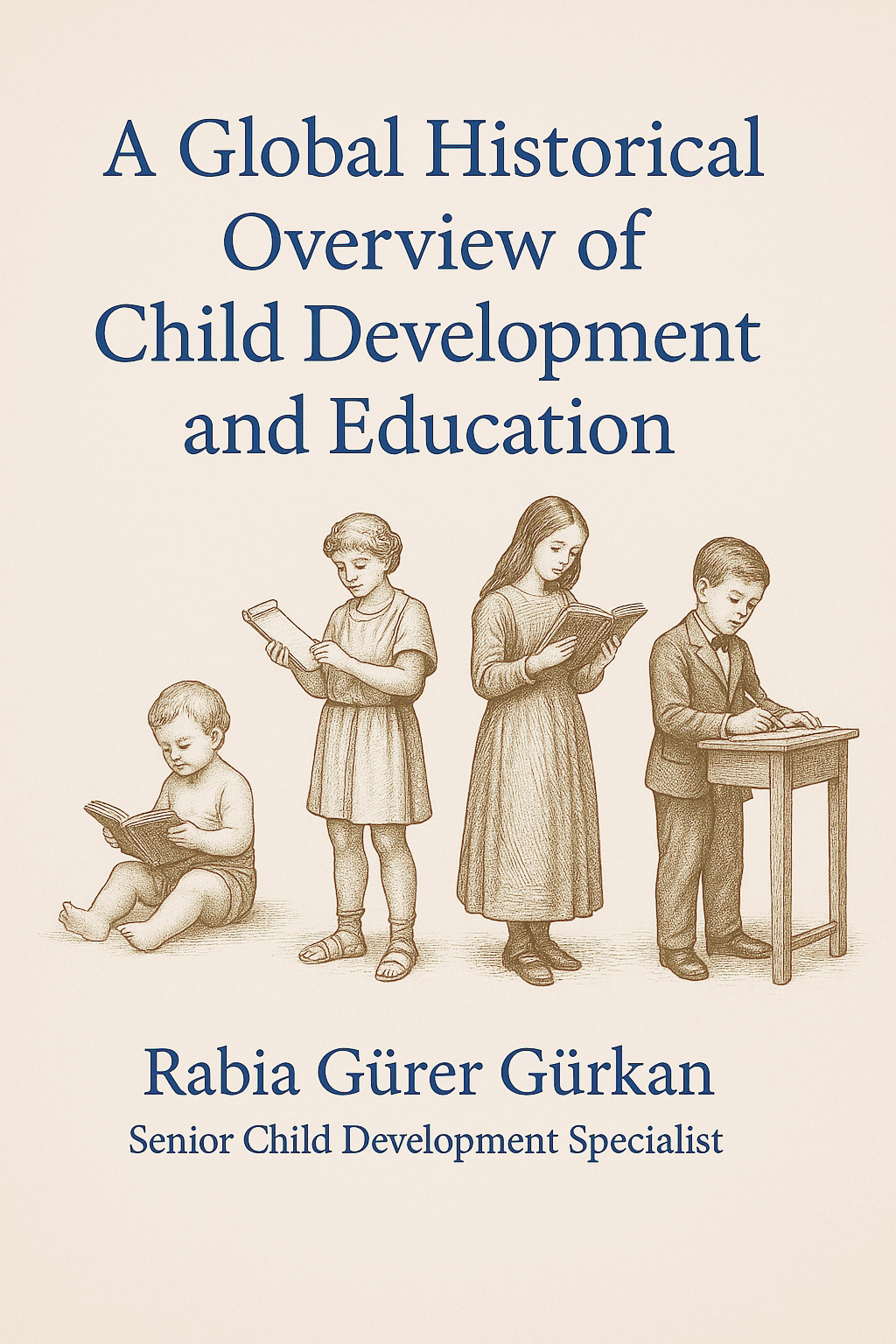
By Rabia GÜRER GÜRKAN, Senior Child Development Specialist
Child development and education have evolved across centuries, shaped by culture, science, philosophy, and social need. From the oral traditions of indigenous societies to today’s evidence-based early intervention programs, the trajectory of how societies understand and nurture children reflects both timeless values and modern innovation. This comprehensive article traces the global history of child development and education, offering a scientific and cultural lens into how humanity has come to prioritize the well-being, learning, and potential of its youngest members.
Ancient Foundations: Pre-Literate and Early Literate Societies
The earliest forms of child development practices were embedded in daily life. In hunter-gatherer societies, children learned through observation, imitation, and participation in communal tasks. These experiential learning methods are now seen as precursors to modern developmental models such as Vygotsky’s sociocultural theory, which emphasizes learning through social interaction.
In early literate societies like those of Mesopotamia, Egypt, India, and China, child education was mostly reserved for elites and focused on religious, administrative, or philosophical training. Texts such as The Instructions of Ptahhotep (Egypt) or The Analects of Confucius (China) contained early notions of moral education and the shaping of character—foundations that still echo in today’s developmental psychology.
Classical and Medieval Views: Children as Incomplete Adults
Greek and Roman civilizations contributed foundational philosophical concepts. Plato emphasized innate abilities and proposed age-based education models in The Republic. Aristotle viewed education as central to developing rationality and virtue. However, in practice, education remained limited to boys from affluent families, and little was understood about the psychology of childhood.
During the Middle Ages in Europe, the dominant worldview saw children as miniature adults, with limited emotional or developmental differentiation. Education was largely religious and didactic. However, Islamic scholars of the same period, such as Avicenna and Al-Ghazali, wrote extensively on child psychology, moral education, and the need for age-appropriate instruction, showing a more nuanced understanding of developmental stages.
Renaissance to Enlightenment: Recognizing Childhood as a Unique Stage
The Renaissance brought renewed interest in human potential, and figures like Erasmus advocated for kindness, play, and moral education. In the Enlightenment, Jean-Jacques Rousseau’s Émile (1762) radically shifted the paradigm by emphasizing natural development and child-centered education. Rousseau posited that children are inherently good and learn best when education aligns with their natural stages of growth.
John Locke’s tabula rasa (blank slate) concept argued that children are shaped entirely by experience, influencing later behaviorist theories. These philosophical models laid the groundwork for pedagogical approaches that recognized the importance of early experiences, cognitive engagement, and emotional care.
The 19th Century: The Birth of Developmental Science
The 19th century witnessed the emergence of developmental psychology and formal schooling systems in Europe and North America. Friedrich Froebel founded the first kindergarten, emphasizing play as a key vehicle for learning. Maria Montessori later developed her child-centered approach based on careful observation and respect for the child’s autonomy, focusing on sensory exploration and practical life skills.
Meanwhile, compulsory education laws began to emerge globally, from Prussia to Japan. These laws recognized the state’s role in shaping future citizens and led to increased public awareness of child welfare, though inequalities based on class, gender, and race persisted.
The 20th Century: Scientific Foundations and Globalization
The 20th century marked a turning point with the emergence of empirical research in child development. Pioneers like Jean Piaget introduced stage-based cognitive development theory, while Erik Erikson’s psychosocial model highlighted the influence of social relationships over the life course.
Behaviorists such as B.F. Skinner emphasized reinforcement and environmental conditioning, whereas attachment theorists like John Bowlby and Mary Ainsworth identified the critical role of emotional bonds in early years. Lev Vygotsky’s work stressed the cultural and social context of learning, giving rise to models still used in educational policy today.
Simultaneously, child development became a focus of public health and human rights. The United Nations Convention on the Rights of the Child (1989) enshrined global commitments to nurture and protect children. International agencies like UNICEF and UNESCO began shaping global standards for early childhood education (ECE), highlighting its importance for sustainable development.
The 21st Century: Neuroscience, Technology, and Holistic Models
Today, child development is informed by neuroscience, digital technologies, and cross-disciplinary insights. Brain imaging has confirmed the critical importance of the first 1,000 days of life, validating early interventions in nutrition, emotional bonding, and stimulation.
Digital technologies offer both opportunities and risks. While educational apps and online learning platforms can foster early skills, excessive screen time and cyber exposure pose new developmental challenges. Researchers and policymakers continue to explore how to integrate technology meaningfully in the lives of young children.
The modern approach is holistic—encompassing physical, cognitive, emotional, and social domains. Concepts like “whole child development,” trauma-informed care, and culturally responsive teaching are gaining traction across the globe. Governments and NGOs have expanded access to preschool education, especially in low- and middle-income countries.
Moreover, parental support programs, intersectoral collaboration between health and education sectors, and gender-inclusive policies have become cornerstones of sustainable child development strategies worldwide.
Regional Contributions and Global Integration
While much of developmental theory originated in Western contexts, diverse traditions have contributed rich perspectives. Indigenous knowledge systems in Africa and the Americas prioritize communal responsibility and oral storytelling. East Asian models emphasize discipline and interdependence. Latin American pedagogues like Paulo Freire have inspired critical, participatory education grounded in social justice.
Global summits, such as the World Conference on Early Childhood Care and Education (ECCE), continue to foster international cooperation, while national frameworks adapt international guidelines to local realities.
The Future of Child Development and Education
The future of child development will depend on addressing inequality, integrating technology ethically, supporting caregivers, and applying scientific findings to policy and practice. Climate change, migration, and pandemics like COVID-19 have underscored the vulnerability of children and the need for resilient, inclusive systems.
Advances in genetics, AI, and behavioral science promise new insights but also demand ethical vigilance. As we move forward, investing in children’s early years is increasingly recognized not just as a moral imperative, but as a strategic pathway to sustainable peace, health, and economic prosperity.
Scientific Sources
Bowlby, J. (1969). Attachment and Loss. Basic Books.
Erikson, E. H. (1950). Childhood and Society. Norton.
Froebel, F. (1887). The Education of Man. Appleton.
Montessori, M. (1912). The Montessori Method. Frederick A. Stokes Company.
Piaget, J. (1952). The Origins of Intelligence in Children. International Universities Press.
United Nations (1989). Convention on the Rights of the Child.
Vygotsky, L. S. (1978). Mind in Society: The Development of Higher Psychological Processes. Harvard University Press.
World Health Organization & UNICEF (2018). Nurturing Care for Early Childhood Development. Geneva.
UNESCO (2022). Global Partnership Strategy for Early Childhood.
Center on the Developing Child at Harvard University. (2023). Brain Architecture and Early Development.
 Rabia Gürer Gürkan – Senior Child Development Specialist